
Portable air compressor for 4×4s
Published March 2, 2023 Updated July 18, 2026 By Gonzalo Solaz
Learn about the author’s experience and limitations. About the author
A portable air compressor is an essential piece of kit for tackling challenging 4×4 routes, particularly when grip and traction are poor (mud, snow, sand), as you can deflate your tyres knowing that you can inflate them again once you’ve finished, rather than having to wait until you reach a petrol station.
This isn’t the only use for it; let’s take a look at what an air compressor is, what types are available and what they’re used for.
Table of contents
- What is a portable air compressor?
- Uses of a portable air compressor in a 4×4
- What should you bear in mind when buying an air compressor?
- How many types of air compressors are there?
- 12V portable air compressor
- 220V portable air compressor
- Battery-powered portable air inflators
- Best air compressor for 4x4s
What is a portable air compressor?
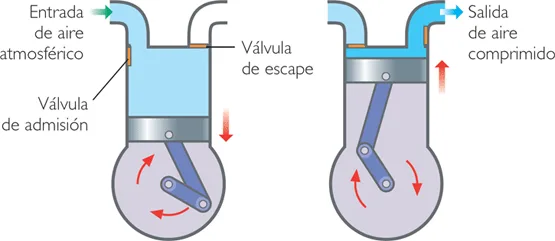
An air compressor is a device used to increase air pressure. It works by drawing in ambient air and compressing it into a smaller space, thereby increasing its pressure. Once compressed, the air is expelled through an outlet at the pressure the motor has been able to generate.
Uses of a portable air compressor in a 4×4
Compressed air in a 4×4 camper van can be used for:
- The main or most common use is to inflate the tyres of your 4×4.
- It can also be used to raise and/or lower the air suspension, if fitted.
- Another use is to power pneumatic tools, such as a pneumatic impact wrench for removing wheels.
- Further uses include attaching an air blow gun to clean filters or other components.
- Finally, it can also be used to activate or deactivate the 4×4’s differential lock system (if fitted and if the system operates in this way).
What should you bear in mind when buying an air compressor?
If you intend to use it primarily for inflating tyres, you should consider:
- The air flow rate, measured in litres per minute. This will determine how long it takes to inflate the tyre.
- The maximum inflation pressure, measured in PSI or BAR.
- Another factor to consider is the noise level, measured in decibels.
- Voltage. As mentioned, there are 12V, 220V and battery-powered models. Prices vary depending on the voltage, with 220V models being the cheapest and most powerful.
- Current. It is important to know the power rating of each model so that, amongst other things, you can determine the correct cable gauge to use.
- Price
How many types of air compressors are there?
Air compressors can be electric, petrol or diesel-powered, or manual. For use in vehicles, we’ll be looking at the electric type. Among the electric models, we can distinguish between 12V, 220V and battery-powered air compressors.
In terms of size, they range from small portable air compressors to large stationary industrial compressors.
12V portable air compressor
This type of compressor connects directly to the battery. They can be connected using clamps attached directly to the battery terminals or via the cigarette lighter socket inside the vehicle. The clamps can also be cut off to create a permanent or fixed installation. This option is best carried out with the appropriate fuses and cable gauge.
– Small air compressor
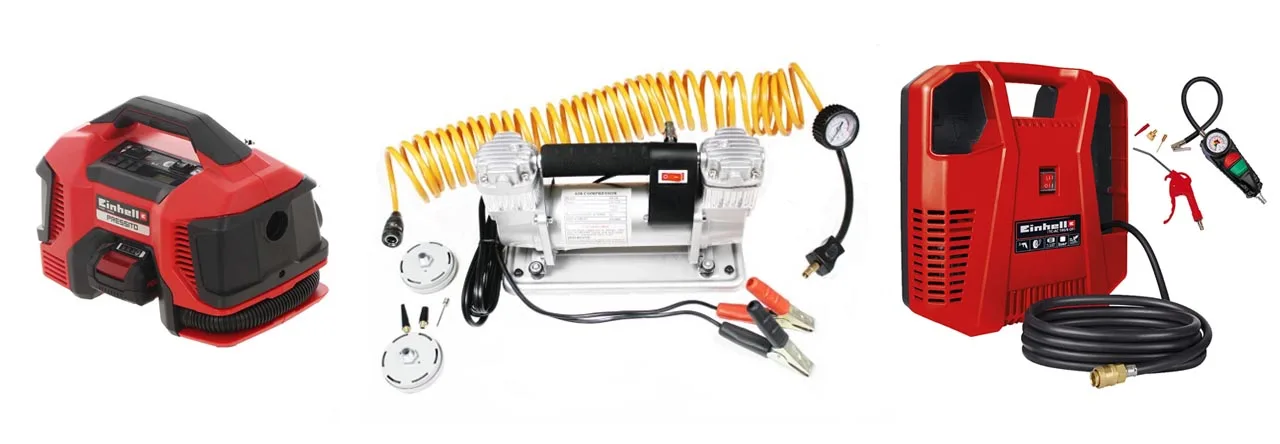
The first three models I’m showing you have similar features. They are small air compressors with flow rates in the range of 60–72 litres per minute. This may be a little low. However, if you’re on a tight budget and your tyres aren’t very large, they may well suit your needs. They’ll take longer than others to complete various tasks, and you won’t be able to use them for long periods as they’ll eventually break down.
– Small, powerful air compressor
The next one I’m showing you has a higher flow rate (160 litres/min), on a par with other compressors from well-known brands. This one, however, is from an unknown Chinese brand. Here we’re starting to get it right in terms of flow rate and maximum inflation pressure.

This air compressor is also available on the Vevor website at a cheaper price than on Amazon.
See offer on VevorNext, we’ll move on to the 12V compressors from T-MAX, which are also made in China.
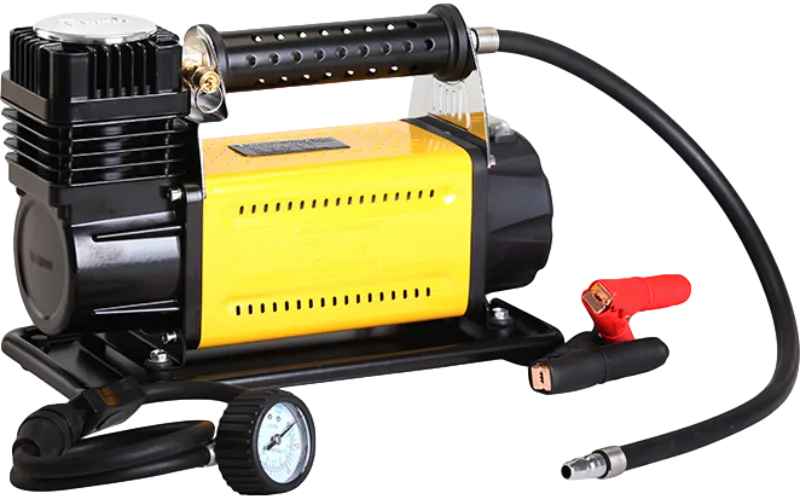
This compressor is very good; it has a flow rate of 160 litres per minute, reaches up to 150 PSI and has a current rating of 45A. It features overheating protection and a pressure switch, and its price ranges between 130 and 150 euros.
– 12V portable air compressors from specialist brands
Within this category of 12V compressors – which, incidentally, are the most common type to carry in a 4×4 vehicle – there are a number of brands that specialise in this field. They tend to perform better, offer good air flow and are of a higher quality. As they use better components, they can handle a higher duty cycle as they dissipate heat more effectively. All these advantages are reflected in the price.
Here we have brands such as VIAIR, although they appear to be more specialised for use with air suspension systems. They are expensive and do not offer particularly high air flow rates.
Another brand worth highlighting is ARB, the specialist brand par excellence, which offers several models in different sizes. Their compressors are designed for inflating tyres and for fitting or removing the wheel chocks featured in their catalogue.
Among their 12V compressors, the twin-cylinder model stands out
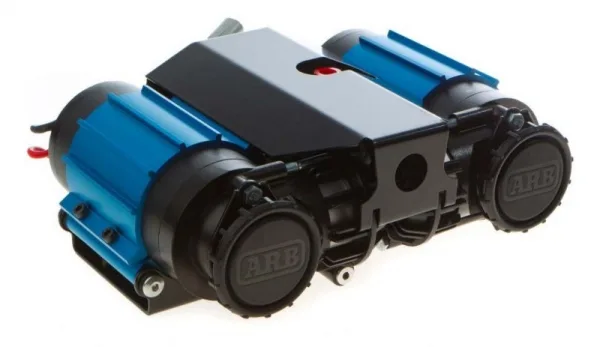
Its specifications include the ability to inflate up to 150 PSI, an air flow rate of 174 litres per minute, 56 amps, and a price ranging from 300 to 600 euros. Yes, you’ve read that correctly; depending on the shop, the price varies.
220V portable air compressor
The 220V option has several advantages worth mentioning. Firstly, these portable air compressors are very easy to handle thanks to their carrying handle; they offer a very good air flow rate of between 160 and 180 litres per minute and typically reach a maximum pressure of 8 bar. Price-wise, they’re usually around 100 euros. On the downside, you’ll need a powerful inverter in your 4×4 as they consume around 1100W, and they’re also very noisy, reaching around 100 dB.
Portable battery-powered air compressors
This option is gradually gaining ground and may well become very appealing. The truth is that, at present, they don’t have much pumping capacity and are expensive, as you also have to buy batteries.
Here I’d like to highlight one that’s ahead of the rest, as it already has a good air flow rate. As we’ve said, the problem is that you have to factor in the cost of two batteries to make it a 36V unit.
Best air compressor for 4x4s
It’s not that one compressor is better than the others. Everyone will have to decide which one suits them best, based on their own circumstances and the information available.
As you’ve seen, specialist brands tend to opt for 12V air compressors. This is undoubtedly the most attractive option, but you shouldn’t rule out other options such as the 220V models I’ve mentioned, or even battery-powered ones.
Having done my research, I’ll most likely go for a 12V model with an air flow rate of around 160 l/min. My tyres, with their large volume, are going to require a fair amount of air, so it’s best to buy a powerful one.
I hope this article has provided you with all the information you need to make the best decision for your setup.